US revises HIV policy to cover all at risk
The United States has acknowledged that its approach to combating HIV must include all people at risk to effectively end the epidemic. The shift in tone comes after criticism over the exclusion of marginalized groups from recent policy changes.
At an event ahead of the International AIDS Conference in Rio de Janeiro, Dr Rebecca Bunnell, deputy head of the U.S. President’s Emergency Plan for AIDS Relief (PEPFAR), stated the program cannot succeed unless it serves every vulnerable population. “We can’t forget any group because if we do, we will fail,” she said.
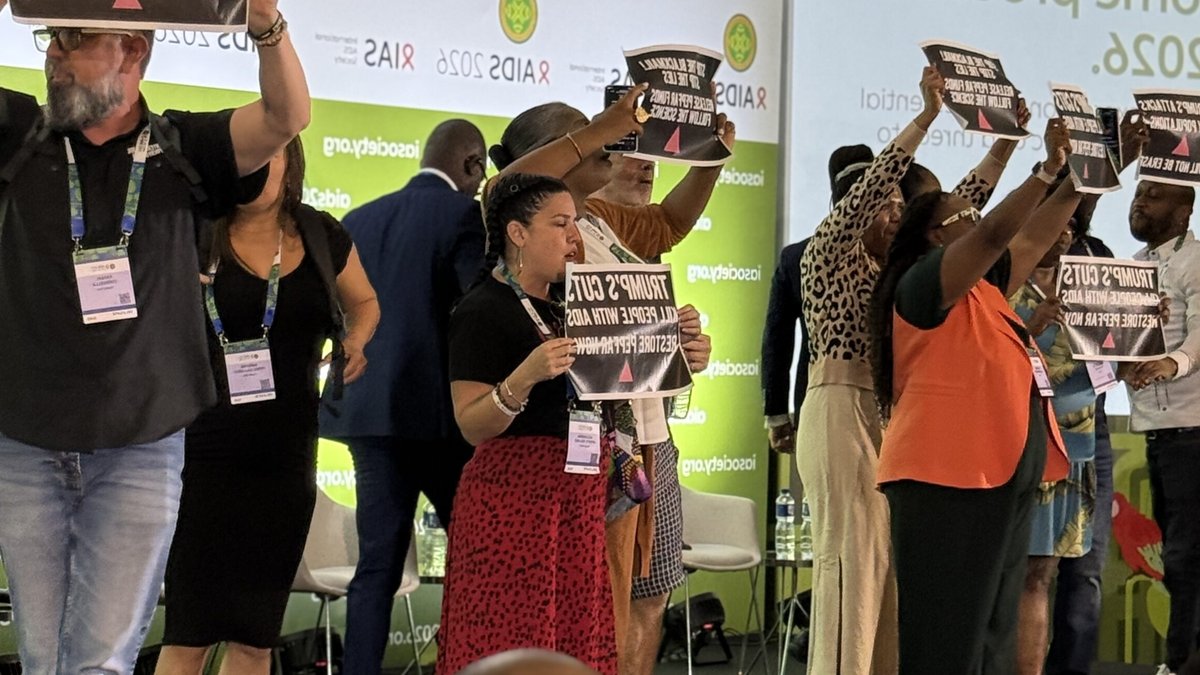
Activists disrupt U.S. health policy session
Bunnell’s comments followed a heated confrontation where HIV activists interrupted the session, blowing whistles and chanting, “You lie, people die. Restore PEPFAR now.” HealthGAP’s Asia Russell seized the microphone from Jeff Graham, the acting U.S. global AIDS coordinator, and accused the administration of pursuing an anti-science agenda. “For months, there has been a public health emergency caused by your government’s deadly disruptions in PEPFAR programming and global health aid,” Russell said. “We will not allow our communities to be erased.”
Graham later responded to claims that the new bilateral agreements, known as memoranda of understanding (MOUs), were tied to mineral extraction. “There are no critical minerals mentioned in any MOU,” he said. Some health agreements, however, were signed alongside separate mineral deals, including those with the Democratic Republic of Congo and Guinea. A proposed MOU with Zambia reportedly collapsed over disagreements on U.S. terms for resource access.
Related: UN Declares Cut in Traffic Deaths; US Votes Against
The agreements require co-financing from partner countries. Nigeria, for example, has committed $3 billion alongside a $2 billion U.S. investment. Graham described the arrangement as a step toward self-reliance but noted that failure to meet financial pledges could lead to reassessment.
Treatment disruptions hit key populations hardest
A study by the Foundation for AIDS Research found that changes to PEPFAR under the previous administration led to widespread disruptions in HIV services. The PEPFAR Pulse Study reported that 1,714 HIV service sites had closed, including over 1,000 public health facilities. The closures disproportionately affected sex workers, men who have sex with men, and people who inject drugs, with more than one in five treatment providers ending at least one clinical service for these groups.
Dr Temitope Ilori, director general of Nigeria’s National Agency for the Control of AIDS, said some programs targeting these populations had been disrupted but were later absorbed into government initiatives.
The U.S. strategy now prioritizes preventing mother-to-child transmission, a focus that has drawn criticism for sidelining other high-risk groups. Bunnell’s comments suggested a partial reversal, though activists argue the policy changes have already caused lasting harm.
Co-financing deals raise questions about sustainability
The MOUs require partner countries to match U.S. funding. Graham framed this as a path to self-sufficiency. “If countries can finance their own health response, that’s ultimately a good thing,” he said. Critics, however, argue the agreements prioritize fiscal targets over patient needs, particularly in nations with strained health budgets.
A transition resilience fund is meant to cushion countries if they struggle to meet co-financing commitments. Yet the rapid timeline for self-reliance in some agreements has left advocates doubtful. In Zambia, negotiations stalled over U.S. demands related to mineral rights, though Graham insisted the MOUs contain no such provisions.
The debate occurs as global HIV funding faces uncertainty. PEPFAR, launched in 2003, has saved millions of lives but has faced political pressure in recent years. Its future funding is now caught in broader partisan battles over foreign aid and social issues.
Bunnell’s remarks indicate recognition that excluding key populations risks undermining progress. Whether this leads to policy changes or remains a rhetorical adjustment is unclear.

UN Declares Cut in Traffic Deaths; US Votes Against


